 Elsa Addison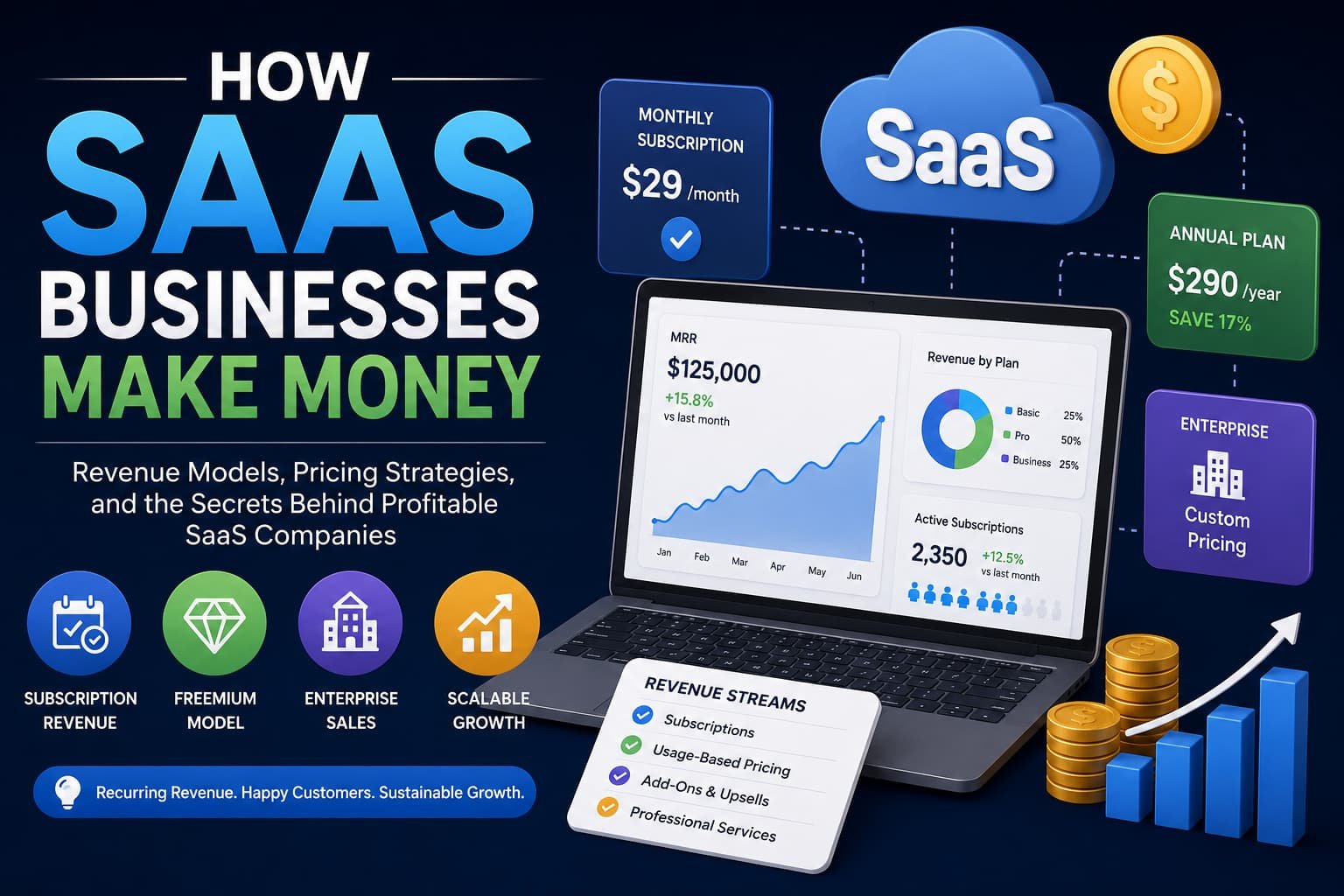
A few years ago, I signed up for a project management tool that promised to organize my work, automate reminders, and help my team collaborate more effectively. The free version was impressive, but after a few weeks, I upgraded to a paid plan without much hesitation.
That’s when I had an interesting realization.
I wasn’t just paying for software. I was participating in one of the most successful business models ever created: Software as a Service (SaaS).
Today, SaaS companies generate billions of dollars annually by delivering software through the cloud instead of selling physical products or one-time software licenses. Companies like Salesforce, HubSpot, Zoom, Canva, Shopify, Slack, and Adobe have transformed how software is sold and consumed.
But how exactly do SaaS businesses make money? Why are investors obsessed with SaaS startups? And what separates profitable SaaS companies from those that struggle?
After researching dozens of SaaS businesses, analyzing revenue models, and testing countless software tools myself, I’ve found that successful SaaS companies don’t rely on a single income source. Instead, they build predictable, recurring revenue streams that compound over time.
In this guide, we’ll break down exactly how SaaS businesses generate revenue, grow profits, and scale into multi-million or even billion-dollar companies.
What Is a SaaS Business?
Software as a Service (SaaS) is a business model where customers access software through the internet instead of purchasing and installing it permanently.
Instead of buying software once, customers typically pay:
- Monthly subscriptions
- Annual subscriptions
- Usage-based fees
- Enterprise contracts
Examples include:
- Salesforce (CRM)
- Shopify (eCommerce)
- Canva (Design)
- Zoom (Video conferencing)
- Dropbox (Cloud storage)
- Notion (Productivity)
The biggest difference is simple:
Traditional software sells a product once.
SaaS sells ongoing access.
That recurring relationship is where the real money is made.
See More: How to Extend Smartphone Battery Life
Why Investors Love SaaS Companies
One reason SaaS businesses attract enormous investment is predictable revenue.
Imagine owning a coffee shop.
Every month, you start at zero and hope customers walk through the door.
Now imagine having 10,000 subscribers automatically paying you every month.
That’s the power of recurring revenue.
In my experience analyzing business models, few industries provide the same level of revenue visibility as SaaS.
The Core Ways SaaS Businesses Make Money
Let’s explore the most common SaaS revenue models.
Subscription Revenue (The Primary Money Maker)
The vast majority of SaaS companies rely on subscription pricing.
Customers pay recurring fees for ongoing software access.
Monthly Subscriptions
Examples:
- Netflix
- Canva Pro
- Notion Plus
- Zoom Pro
Benefits:
- Lower barrier to entry
- Easy customer acquisition
- Flexible upgrades
Challenges:
- Higher churn rates
- Less predictable long-term commitment
Annual Subscriptions
Many SaaS companies encourage annual payments by offering discounts.
For example:
- $20/month = $240/year
- Annual plan = $180/year
Customers save money.
The company receives cash upfront.
Everyone wins.
Freemium Models
One of the most effective SaaS growth strategies is the freemium model.
Users receive basic functionality for free while advanced features require payment.
Companies That Use Freemium Successfully
- Canva
- Dropbox
- Slack
- Grammarly
- Trello
I was skeptical of freemium models when I first studied SaaS businesses.
Why give away your product for free?
Then I realized the genius behind it.
Free users become marketing channels.
They recommend the software, create awareness, and eventually convert into paying customers.
Tiered Pricing Models
Most SaaS businesses offer multiple pricing levels.
Example SaaS Pricing Structure
Basic Plan
Ideal for individuals
Features:
- Limited storage
- Basic reporting
- Standard support
Professional Plan
Designed for growing teams
Features:
- Advanced tools
- Team collaboration
- Integrations
Enterprise Plan
Built for large organizations
Features:
- Custom security
- Dedicated support
- Advanced analytics
- SLA guarantees
This strategy increases average revenue per user (ARPU).
Instead of charging everyone the same amount, businesses capture value from different customer segments.
Usage-Based Pricing
Some SaaS companies charge customers based on actual usage.
This is often called consumption pricing.
Examples include:
- AWS
- Twilio
- Stripe
- OpenAI API
Customers pay for:
- API requests
- Data storage
- Messages sent
- Transactions processed
Why Usage Pricing Works
Revenue grows alongside customer success.
When customers use more resources, they naturally pay more.
This alignment creates powerful scalability.
Enterprise Contracts
Enterprise customers often generate the majority of SaaS revenue.
A small startup may pay:
- $20/month
A Fortune 500 company may pay:
- $50,000+ annually
or even
- Millions per year
Enterprise Revenue Advantages
Benefits include:
- Higher contract values
- Longer retention
- Stable cash flow
- Lower churn
Salesforce built much of its growth through enterprise contracts.
Many B2B SaaS companies follow a similar path.
Add-On Services and Upsells
Subscription fees aren’t always enough.
Successful SaaS companies often increase revenue through add-ons.
Examples:
- Extra storage
- Premium support
- Additional users
- Advanced analytics
- Custom integrations
Dropbox and Google Workspace are excellent examples.
Customers frequently start with basic plans and expand usage over time.
Professional Services Revenue
Some SaaS companies offer services alongside software.
Examples include:
- Implementation
- Training
- Consulting
- Data migration
- Custom development
When I worked with a CRM implementation project, the software license represented only part of the deal.
The setup and consulting services generated substantial additional revenue.
For many enterprise SaaS companies, services become a significant profit center.
How SaaS Businesses Become Profitable
Revenue alone doesn’t guarantee success.
Profitability depends on balancing growth and costs.
Key SaaS Metrics That Matter
Monthly Recurring Revenue (MRR)
MRR tracks predictable monthly income.
Formula:
Monthly Subscribers × Monthly Price
Example:
1,000 customers × $50/month
= $50,000 MRR
Annual Recurring Revenue (ARR)
ARR measures yearly recurring income.
Investors frequently use ARR to value SaaS companies.
Customer Acquisition Cost (CAC)
CAC measures how much it costs to acquire a customer.
Includes:
- Advertising
- Sales salaries
- Marketing expenses
Customer Lifetime Value (LTV)
LTV estimates total customer revenue over their relationship with the company.
Healthy SaaS businesses typically maintain:
LTV > CAC
The larger the gap, the better.
Common SaaS Challenges and How Companies Solve Them
Challenge 1: High Customer Churn
Customers cancel subscriptions.
Solution:
- Better onboarding
- Improved support
- Feature expansion
- Customer success teams
Challenge 2: Pricing Mistakes
Many startups undercharge.
Solution:
Regular pricing reviews and customer feedback.
Challenge 3: Slow Growth
Acquiring customers can become expensive.
Solution:
- SEO content marketing
- Referral programs
- Product-led growth
- Partnerships
Product-Led Growth: The Modern SaaS Engine
One trend I’ve seen repeatedly is product-led growth (PLG).
Instead of relying heavily on sales teams, the product itself drives conversions.
Examples:
- Slack
- Zoom
- Notion
- Canva
Users try the product.
They experience value.
Then they upgrade.
This approach often reduces acquisition costs while accelerating growth.
Real-World SaaS Revenue Examples
Shopify
Revenue sources:
- Monthly subscriptions
- Transaction fees
- Shopify Payments
- App marketplace
Canva
Revenue sources:
- Canva Pro subscriptions
- Teams plans
- Enterprise plans
Adobe
Revenue sources:
- Creative Cloud subscriptions
- Enterprise licensing
- Stock image services
These examples demonstrate that the strongest SaaS businesses often diversify revenue streams.
Quick Tips for Building a Profitable SaaS Business
- Focus on solving one painful problem exceptionally well.
- Prioritize customer retention over rapid acquisition.
- Use free trials strategically.
- Monitor churn obsessively.
- Build recurring revenue first.
- Continuously improve onboarding.
- Experiment with pricing regularly.
- Invest in customer success.
FAQs
What is the main way SaaS businesses make money?
Most SaaS companies generate revenue through recurring subscriptions. Customers pay monthly or annually to access software and ongoing updates.
Are SaaS businesses profitable?
Many SaaS businesses become highly profitable once they achieve scale. Their recurring revenue model creates predictable cash flow and strong long-term margins.
Why do SaaS companies offer free plans?
Free plans help attract users, build awareness, and create opportunities to convert customers into paid subscribers through premium features and upgrades.
What is the difference between SaaS and traditional software?
Traditional software is often purchased once, while SaaS software is accessed online through recurring subscriptions that include updates, maintenance, and support.
Final Thoughts
Understanding how SaaS businesses make money reveals why this model has become one of the most powerful forces in modern business.
At its core, SaaS is built around recurring revenue, customer retention, and scalable growth. Whether it’s Canva converting free users into premium subscribers, Shopify earning revenue from merchants, or Salesforce closing large enterprise contracts, the principle remains the same: create ongoing value and customers will continue paying for access.
In my experience, the most successful SaaS companies don’t focus solely on acquiring customers. They focus on keeping them. A loyal customer who stays for years is often worth far more than dozens of short-term signups.
As cloud technology continues to expand and businesses become increasingly digital, SaaS will likely remain one of the most attractive and profitable business models in the world.
What SaaS tools do you use most often? Understanding the products you already pay for is one of the best ways to learn how successful SaaS businesses really work.