 Stephen Galvin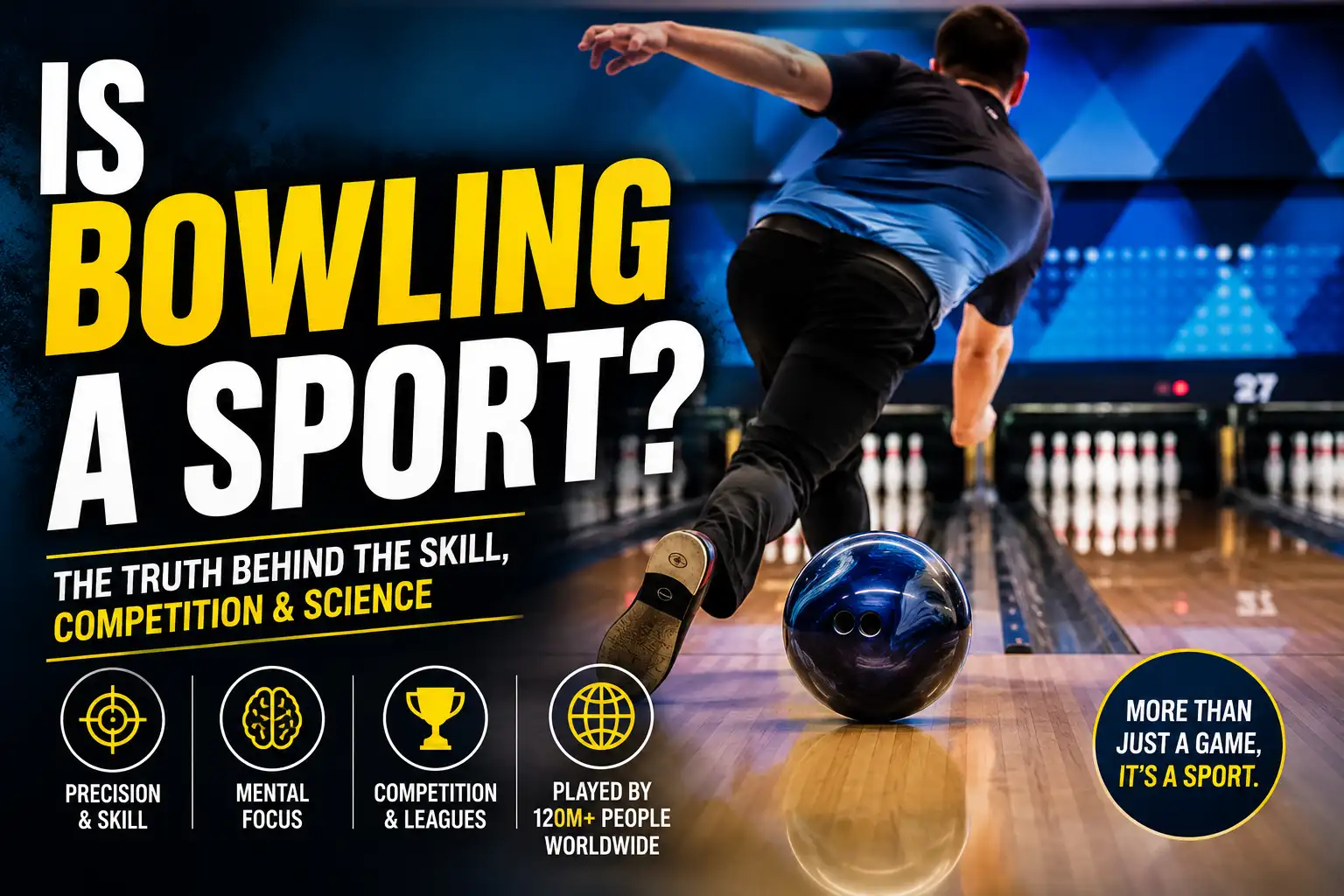
Introduction: The Question Everyone Argues About
Every time I step into a bowling alley, I hear the same mix of sounds, rolling balls, cheering lanes, and someone laughing over a gutter ball. But I also hear the same question repeated again and again:
“Is bowling actually a sport… or just a hobby?”
I used to think it was just a fun weekend activity too. Shoes, snacks, light competition, nothing serious, right?
But the more I observed league nights, professional broadcasts, and even technical breakdowns of ball motion, the more that belief started to change.
Because behind every throw, there’s precision. Behind every strike, there’s strategy. And behind the calm atmosphere, there’s real athletic pressure.
In this article, I’ll break down bowling using real rules, science-backed data, competitive structure, and global recognition to answer the question properly:
Is bowling a sport?
Overview
Yes, bowling is widely recognized as a competitive, technical, and professional sport, not just a recreational pastime. It qualifies as a target-based precision sport, requiring physical control, mental focus, and strategic adjustment.
Modern bowling includes professional leagues like the Professional Bowlers Association, governed by organizations such as the International Bowling Federation, and structured under national bodies like the United States Bowling Congress.
Key reasons it is classified as a sport:
- It demands high precision and repeatable technique
- It involves complex physical and mental coordination
- It uses standardized rules and lane conditions
- It features global competitions and professional rankings
While often seen as casual entertainment, elite bowling is a skill-dominant competitive sport played by over 120 million people worldwide, featured in events like the Pan American Games and Asian Games, though not currently part of the Olympics.
What Makes Bowling a Sport? (Core Definition)
To answer this properly, I used the same criteria applied to recognized sports like golf and archery:
Physical Skill
Bowling requires:
- Controlled arm swing mechanics
- Balance during approach
- Wrist rotation and release precision
- Repetitive accuracy under fatigue
At elite level, even a 1–2 degree change in release angle can change the result completely.
Scientific Physical Demand
Bowling is measured at around:
3.0\ \text{METs}
That places it in moderate-intensity physical activity, similar to golf and archery—not extreme cardio, but still physically demanding over long sessions.
Codified Rules & Governance
Bowling is highly regulated:
- Lane length: 60 feet
- Ball weight: up to 16 lbs
- Standard scoring system (frames, strikes, spares)
All official rules are managed by governing bodies like USBC and IBF.
Objective Scoring System
Unlike judged sports (like gymnastics), bowling is fully numeric:
- Pins knocked down = score
- No subjective judging involved
- Every result is measurable and repeatable
My Personal Observation: What Changed My Mind
I still remember watching a league night where a bowler needed a strike in the final frame to win.
The entire alley went silent.
No music. No distractions. Just one roll.
He adjusted his stance slightly, changed his angle, and released the ball with surgical precision.
Strike.
That moment made me realize something important:
This wasn’t luck. It was calculation under pressure.
And that’s where bowling stops being a hobby and becomes a sport.
How Bowling Actually Works
Lane Conditions Matter More Than People Think
Oil patterns on lanes completely change gameplay:
- Heavy oil = less friction
- Dry lanes = more hook
- Sport patterns = precision-based strategy
Professional bowlers constantly adjust:
- Ball speed
- Rotation (rev rate)
- Angle of entry
Equipment Is Highly Technical
A bowling ball is not “just a ball.”
Players use:
- Reactive resin balls for hook potential
- Urethane for controlled motion
- Plastic balls for spare accuracy
Even finger hole drilling is customized based on:
- Hand span
- Grip style
- Rotation axis
Mental Pressure Is Real
In professional play:
- One missed spare can cost a match
- Consistency matters more than power
- Focus must be maintained for hours
That mental strain is similar to golf or darts under competition conditions.
Read More About: Is Marching Band a Sport?
Professional Bowling Exists (And It’s Serious)
Bowling is not just casual leagues.
It has structured professional pathways:
Major Organizations
- PBA Tour (professional circuit)
- USBC national competitions
- International tournaments governed by IBF
Prize Money & Rankings
Top-level bowlers earn:
- Tournament prize winnings
- Sponsorship deals
- Ranked points across seasons
This is identical to other recognized professional sports ecosystems.
Bowling clearly fits the precision sport category, just like golf and archery.Global Recognition of Bowling
Bowling is played by over 120 million people worldwide and appears in:
- Pan American Games
- Asian Games
- World Games
Even though it is not currently in the Olympics, it still holds international competitive legitimacy through structured federations and global events.
Common Misconception: “It’s Just a Hobby”
This is where most debates happen.
Reality:
- Casual bowling = hobby
- League/pro bowling = sport
- The difference is:
- Rules enforcement
- Standardized competition
- Measured performance
- Rankings and progression
Same activity—different level of structure.
Key Problems Bowlers Face (And Real Solutions)
Problem: Inconsistent throws
Solution: Improve release timing and grip fit
Problem: Missing spares
Solution: Use spare system targeting (corner-to-center adjustment)
Problem: Lane unpredictability
Solution: Learn oil pattern reading
Problem: Fatigue in long games
Solution: Focus on stance stability and controlled approach
Quick Insight Summary
- Bowling is a precision-based competitive sport
- Governed by international and national organizations
- Requires measurable physical + mental skill
- Includes professional leagues and global tournaments
- Played by millions worldwide across multiple formats
FAQs
1. Is bowling a real sport or just entertainment?
Bowling is a real sport because it involves structured rules, competition, scoring systems, and professional leagues like the PBA.
2. What makes bowling different from casual games?
Casual bowling is recreational, but sport bowling involves strategy, oil pattern reading, and consistent high-level performance under pressure.
3. Is bowling physically demanding?
Yes, bowling is a moderate-intensity activity requiring balance, strength, repetition control, and mental focus over long durations.
Conclusion: So, Is Bowling a Sport?
After breaking down the rules, science, competition, and global structure, the answer becomes clear:
Bowling is absolutely a sport, but a precision and skill-based one, not a high-contact athletic sport.
It rewards:
- Consistency over strength
- Strategy over speed
- Precision over power


 Elsa Addison