 Mark Jones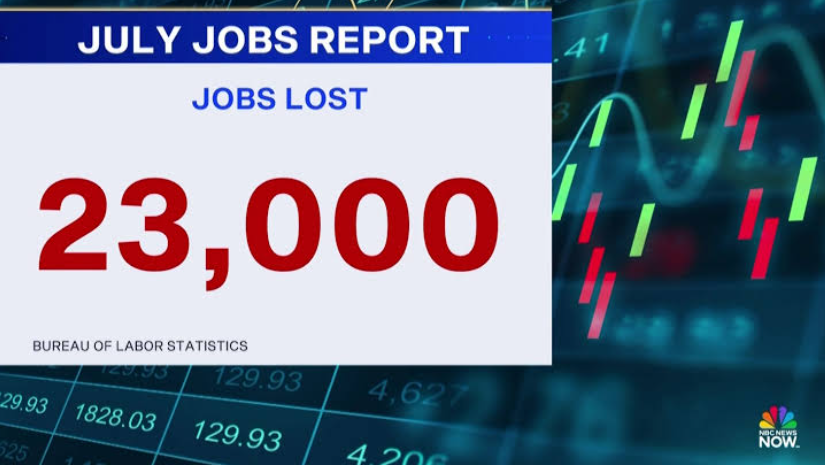
The U.S. labor market delivered an unexpected surprise in July 2026: instead of adding jobs, the economy lost 23,000 nonfarm payroll jobs.
That result was far weaker than economists had anticipated and adds another warning sign that hiring has cooled considerably. The unemployment rate actually edged down from 4.2% in June to 4.1% in July, but that improvement needs some context. The labor force participation rate also declined to 61.4%, meaning fewer people were working or actively looking for work.
I find this combination particularly interesting because it shows why looking at just one number can give the wrong impression about the U.S. job market. A lower unemployment rate sounds positive at first, but when participation is falling at the same time, it can point to a less encouraging story.
The latest U.S. Bureau of Labor Statistics employment report confirms that nonfarm payroll employment fell by 23,000 in July while the unemployment rate changed little.
Overview
The U.S. unemployment rate stood at 4.1% in July 2026, which remains relatively low by historical standards. However, the latest U.S. Bureau of Labor Statistics data shows that the economy unexpectedly lost 23,000 jobs, while the decline in the unemployment rate was accompanied by a shrinking labor force.
Recent Labor Market Shifts
- Unemployment Rate: The unemployment rate declined from 4.2% in June to 4.1% in July.
- Job Growth: U.S. nonfarm payroll employment fell by 23,000 jobs in July instead of recording the expected increase.
- Participation Drop: The labor force participation rate fell to 61.4%, its lowest level since February 2021.
Underlying Economic Factors
- Weakening Hiring: Job growth has slowed substantially compared with the stronger employment rebound seen after the pandemic.
- Downward Revisions: Earlier payroll figures were revised lower, suggesting the labor market was weaker than previous estimates indicated.
- Sector Weakness: Local government education and retail employment declined, while healthcare remained one of the more important sources of job growth.
The Federal Reserve will also have to consider this labor-market weakness alongside upcoming inflation data when assessing the path of interest rates.
July Jobs Report: The Key Numbers
The headline figure is difficult to miss: the U.S. economy lost 23,000 jobs in July.
Economists surveyed before the release had expected employers to add jobs, making the actual result a significant disappointment.
The important numbers to understand are:
- July nonfarm payrolls: down 23,000
- Unemployment rate: 4.1%
- June unemployment rate: 4.2%
- Labor force participation: 61.4%
- Local government education jobs: down 50,000
- Retail jobs: down 19,000
- Healthcare jobs: up 22,000
- May and June payroll revisions: substantially lower than previously reported
The BLS data also shows that the recent employment picture has become much softer than the labor market’s earlier post-pandemic performance.
For me, the most important takeaway isn’t simply that 23,000 jobs disappeared. It’s that the report combines weak job creation, downward revisions and declining labor-force participation.
That combination deserves more attention than the headline alone.
Why Did the U.S. Lose 23,000 Jobs in July?
Several industries contributed to the decline.
The largest drag came from local government education, which lost around 50,000 jobs. Retail employment also declined by 19,000.
Healthcare was one of the brighter areas, adding 22,000 jobs. However, even healthcare’s performance was not as strong as its recent trend.
This matters because healthcare has been one of the major engines of U.S. payroll growth. When one of the strongest employment sectors continues growing but cannot offset losses elsewhere, it tells us that job creation is becoming less broad-based.
Local Government Education Jobs Declined
Local government education was a major source of the July decline.
Education employment can also be affected by seasonal patterns, school calendars and government payroll adjustments, so one month’s movement should not automatically be treated as a permanent trend.
Still, the size of the decline was large enough to influence the overall July jobs report.
Retail Employment Fell
Retail also lost jobs during July.
Retail is particularly useful to watch because it connects the labor market with consumer spending. When retailers reduce hiring or employment, economists often pay attention to what it could mean for consumer demand and business confidence.
Healthcare Remained a Source of Job Growth
Healthcare added 22,000 jobs and continued to stand out as one of the more resilient parts of the labor market.
However, recent data suggests that healthcare’s pace of job creation has moderated compared with its stronger average gains.
That leaves an important question: if healthcare is no longer producing exceptionally strong gains and other industries are cutting jobs, where will future payroll growth come from?
Earlier Jobs Numbers Were Revised Lower
One part of the July employment report that I would not overlook is the revision to previous months.
The Labor Department revised earlier payroll estimates downward by a combined amount of roughly 103,000 jobs for May and June, according to the figures highlighted in reporting around the release.
Revisions are normal in employment data. Initial payroll estimates are not final and can change as more information becomes available.
But large downward revisions change the story.
Instead of saying:
“July was simply a bad month,”
the broader interpretation becomes:
“The labor market may have been losing momentum for longer than the initial data suggested.”
That is why economists, investors and the Federal Reserve pay attention not only to the newest monthly number but also to changes in previous reports.
Unemployment Falls to 4.1% So Why Isn’t That Good News?
At first glance, the unemployment rate falling from 4.2% to 4.1% sounds encouraging.
But there is an important distinction between unemployment and labor-force participation.
The unemployment rate generally measures people who are unemployed and actively looking for work as a share of the labor force.
If someone stops looking for work altogether, that person may no longer be counted as unemployed.
This means the unemployment rate can decline even when the underlying employment picture isn’t improving.
That’s essentially what happened in July.
The labor force participation rate fell to 61.4%, its lowest level since February 2021.
So I wouldn’t describe July’s lower unemployment rate as evidence of a stronger hiring market without also mentioning participation.
Labor Force Participation Falls to 61.4%
The labor force participation rate measures the percentage of the civilian population that is either working or actively looking for work.
A declining participation rate can happen for several reasons.
Some people may:
- retire
- stop searching because suitable jobs are difficult to find
- return to school
- leave the workforce for family reasons
- become discouraged about employment opportunities
- face other barriers to participating in the labor market
The Federal Reserve Bank of St. Louis has also examined how changes in population measurement can affect labor-force participation statistics.
That statistical factor is worth remembering, because not every movement in the participation rate necessarily represents a sudden change in workers’ behavior.
At the same time, demographic forces are important.
An aging U.S. population means more baby boomers are reaching retirement age. Over time, that can put downward pressure on labor-force participation even if the economy itself remains relatively healthy
Is the U.S. Labor Market Actually Weakening?
After looking through the employment numbers, I think the better description is a cooling labor market rather than an economy suddenly collapsing.
There are two very different signals happening at the same time.
Hiring is weak
Employers are not creating jobs at the pace seen during the post-pandemic recovery.
Job postings and hiring activity have also remained relatively subdued.
For people searching for work, this can create a frustrating situation: there may not be a wave of layoffs, but there also aren’t enough new opportunities being created.
Layoffs remain relatively low
This is the other side of the story.
Recent labor-market data has shown layoffs remaining low, while weekly initial unemployment claims have also remained historically subdued.
That means the labor market is not behaving like a classic severe downturn in which companies are simultaneously cutting large numbers of workers.
Instead, the current picture looks more like:
low hiring + low layoffs = a slow-moving labor market.
That’s an important distinction.
What Job Seekers Are Experiencing
The national unemployment rate doesn’t always tell job seekers what the market feels like.
Someone can technically live in an economy with a 4.1% unemployment rate and still struggle to find work.
If companies are posting fewer positions, delaying hiring decisions or receiving hundreds of applications for a single opening, competition becomes much tougher.
LinkedIn labor-market data has pointed toward subdued hiring and job-posting activity, while applications per applicant have increased.
In practical terms, that can mean:
- More people compete for the same openings.
- Employers have a larger pool of applicants.
- Hiring processes may take longer.
- Candidates may need stronger skills or experience.
- Young workers can face particularly difficult entry-level conditions.
This is why I would pay attention to job-seeking intensity, not just the headline unemployment rate.
What Experts Are Saying About the July Jobs Report
Economists have generally described the labor market as slower than during the post-pandemic employment rebound.
Kory Kantenga of LinkedIn has characterized the hiring environment as slow, particularly for younger workers. The broader message is that unemployment can remain relatively stable even when employers are not meaningfully increasing hiring.
Other labor economists have pointed to the falling participation rate as another important part of the story.
The aging U.S. population is one structural factor. Retirement naturally removes people from the labor force, and demographic trends can continue influencing participation over the next several years.
Immigration policy can also affect labor-force growth because changes in the number of working-age people entering the country can influence the available workforce.
The important lesson is that employment data is rarely driven by one factor.
Wages Are Another Part of the Story
Workers with jobs are facing another challenge: rising consumer prices can reduce the benefit of higher wages.
Nominal wages can increase while purchasing power still feels squeezed if prices rise quickly.
For example, suppose a worker receives a 4% pay increase but the cost of important household expenses rises by a similar or greater amount. On paper, income has increased, but the worker may not feel significantly better off.
This is why economists watch:
- wage growth
- inflation
- consumer prices
- real wage growth
- purchasing power
The labor market is not just about whether someone has a job. The quality of that employment and what the paycheck can actually buy matter too.
What Does the July Jobs Report Mean for the Federal Reserve?
This is where the July jobs report becomes especially important for financial markets.
The Federal Reserve has to balance two major concerns:
employment and inflation.
A weaker labor market can reduce pressure for higher interest rates because the Fed does not want monetary policy to become unnecessarily restrictive.
But inflation remains a critical issue.
If inflation is still significantly above the Federal Reserve’s 2% target, policymakers may hesitate to lower rates or may continue considering whether additional tightening is necessary.
That creates a difficult balancing act.
A weak jobs report could reduce pressure for a rate hike
The unexpected loss of 23,000 jobs makes the case for immediately raising rates less straightforward.
Markets responded by reassessing expectations for a potential September rate increase.
Inflation data could change the picture
The jobs report is important, but it isn’t the only piece of information the Fed considers.
If upcoming inflation data comes in hotter than expected, policymakers could still prioritize price stability despite weaker employment.
That’s why the next inflation report will be closely watched.
Will the Federal Reserve Raise Interest Rates in September 2026?
The July jobs report makes a September rate hike less certain, but it does not settle the question.
The Federal Reserve will consider a combination of:
- Employment growth
- Unemployment
- Labor-force participation
- Wage growth
- Inflation
- Consumer spending
- Broader economic activity
The Fed has held rates steady through several recent meetings, while some officials have remained open to additional action if inflation remains too high.
The latest market reaction suggests that investors have reduced expectations for a September hike following the weak July employment report.
In my view, the biggest mistake would be to treat the July jobs report as an automatic signal that rates must fall.
The more accurate interpretation is that the report gives the Fed another reason to proceed cautiously.
What the July Jobs Report Means for American Workers
For workers and job seekers, the report offers several practical lessons.
If you’re looking for work
Don’t rely on the unemployment rate alone.
Focus on industries and occupations where hiring remains comparatively healthy, and keep your skills aligned with current employer demand.
If you’re employed
A weak hiring market does not automatically mean widespread layoffs are coming. In fact, low layoffs remain one of the more reassuring parts of the current labor-market picture.
Still, maintaining employable skills is valuable when job creation slows.
If you’re considering changing jobs
A slower hiring market can make switching employers more difficult.
Before leaving a current position, consider:
- how many relevant openings exist
- how competitive those openings are
- whether your skills match current demand
- how long similar roles typically take to fill
If you’re a young worker
Entry-level workers may feel the slowdown more strongly because they often have less experience and compete for a smaller number of positions.
Building practical skills, gaining relevant experience and applying selectively can be more useful than simply sending out a large number of applications.
What Should We Watch Next?
The July jobs report is only one monthly snapshot.
The next important signals will include:
- inflation data
- future monthly payroll reports
- unemployment claims
- labor-force participation
- wage growth
- job openings
- hiring activity
- Federal Reserve statements
- the September FOMC meeting
I would especially watch whether the next employment reports confirm July’s weakness or show that the decline was temporary.
That distinction will matter enormously.
If hiring rebounds, July could turn out to be a weak month influenced by sector-specific factors.
If weak payroll growth continues and previous months continue to be revised lower, concerns about a broader labor-market slowdown will become harder to dismiss.
July Jobs Report FAQs
How many jobs did the U.S. lose in July 2026?
The U.S. economy lost 23,000 nonfarm payroll jobs in July 2026, according to the Bureau of Labor Statistics.
What was the unemployment rate in July 2026?
The unemployment rate fell to 4.1% in July, down from 4.2% in June.
Why did unemployment fall when the economy lost jobs?
The unemployment rate declined partly because the labor force participation rate also fell. When people stop actively looking for work, they may no longer be counted as unemployed.
What happened to labor-force participation?
The labor force participation rate dropped to 61.4%, its lowest level since February 2021.
Which sectors lost the most jobs?
Local government education and retail were among the major areas contributing to the July employment decline.
Did healthcare add jobs?
Yes. Healthcare added approximately 22,000 jobs in July and remained one of the stronger areas of employment growth.
What does the jobs report mean for the Federal Reserve?
The weak employment data could reduce pressure for an immediate rate increase, but the Fed will also consider inflation and other economic indicators before making a decision.
Does the report mean the U.S. economy is in a recession?
Not by itself. One weak monthly jobs report does not establish a recession. Economists typically examine a much broader range of economic indicators and trends.
Final Takeaway
The July 2026 jobs report is more complicated than the headline “23,000 jobs lost” suggests.
The U.S. economy unexpectedly shed jobs, previous payroll figures were revised lower, and labor-force participation fell to 61.4%. At the same time, unemployment declined to 4.1%, layoffs remained relatively low, and healthcare continued adding jobs.
So, is the U.S. labor market collapsing? The data does not support such a simple conclusion.
What it does show is a labor market that has become noticeably less energetic. Hiring is weaker, competition for available jobs is increasing, and employers are not adding workers as quickly as they once did.
For the Federal Reserve, that creates a difficult decision. A cooler labor market argues for caution on interest rates, while persistent inflation could still argue for tighter policy.
The next few months will therefore be more important than this single report. If hiring remains weak and downward revisions continue, July may prove to be an early warning of a broader slowdown. If hiring rebounds, the month could instead look like a temporary setback.
For now, the clearest lesson is simple: don’t judge the U.S. job market by the unemployment rate alone. Look at hiring, participation, layoffs, wages and revisions together.