
 Stephen Galvin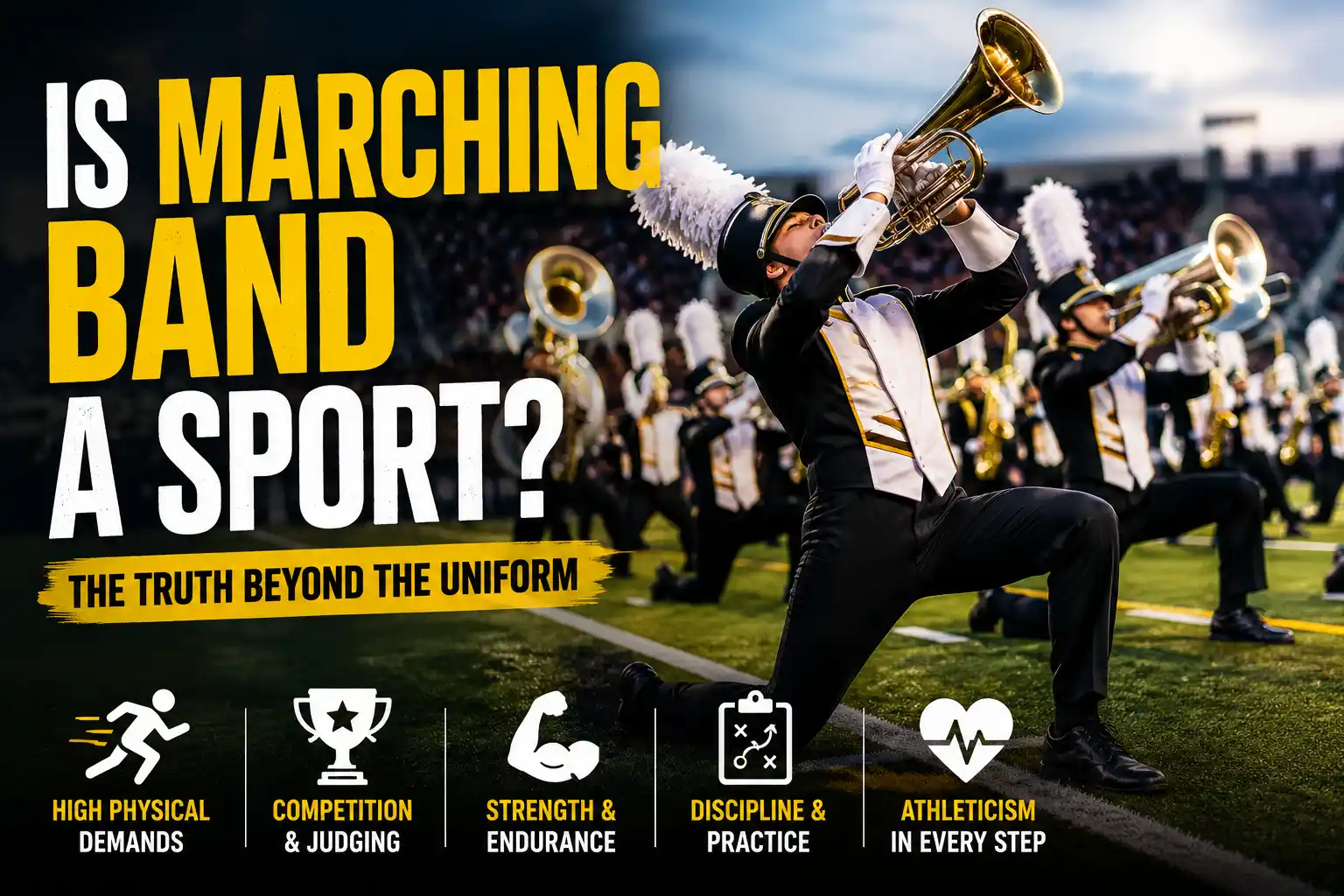
Introduction:
I’ve heard the question “Is marching band a sport?” more times than I can count, and honestly, it’s not as simple as a yes or no answer. Some people instantly say “of course not,” while others strongly argue it deserves full athletic recognition.
In my experience researching and observing marching bands closely, I’ve realized that the truth sits somewhere in the middle, but leans much closer to “yes” than most people expect.
Modern marching band performances are physically demanding, highly competitive, and structured with strict rules. When you really break it down, it starts looking a lot like a sport wrapped inside a performance art.
So let’s explore this properly and understand what marching band really is and whether it deserves the title of a sport.
Understanding What a Sport Actually Means
Before labeling anything, it helps to define what we mean by a “sport.” Generally, a sport includes:
- Physical exertion and endurance
- Skill-based performance
- Structured rules and scoring
- Competition against others
- Training and discipline
Now, when I compare marching band to this list, things start getting interesting. It doesn’t look like traditional sports such as football or basketball, but it checks far more boxes than most people assume.
What Marching Band Really Looks Like in Practice
When I first looked deeper into competitive marching bands, especially high-level circuits like DCI (Drum Corps International), I was surprised by the intensity.
Members don’t just “perform music.” They train like athletes.
Here’s what a typical high-level marching band experience involves:
- Hours of daily rehearsals in extreme heat
- Carrying heavy instruments while marching long distances
- Memorizing complex formations and choreography
- Performing synchronized movements while playing perfectly in tune
- Repeating drills until every movement is flawless
Some performers reportedly burn up to 5,000 calories per day during peak training. That’s comparable to endurance athletes.
And this is where the debate becomes real.
Overview
Based on research and real-world observations, here’s a clear and more natural way to understand it:
Marching band is widely considered by many experts to be an athletic performing art. While it is sometimes categorized as a performance activity, it still fits many definitions of a sport because of its intense physical demands, structured competition, and strict performance standards.
Participants often undergo extreme physical exertion, including marching long distances while carrying instruments. In many cases, they train at a level similar to athletes in competitive sports.
Competitions are also judged very seriously. Just like gymnastics or figure skating, performances are evaluated based on precision, synchronization, creativity, and execution.
In fact, elite marching groups often require conditioning comparable to Division I sports teams.
So while it may not be a “traditional sport,” it definitely operates within a sports-like structure.
Read More About: What Is Sports Psychology?
Why Many People Consider Marching Band a Sport
1. Extreme Physical Demands
One of the strongest arguments is the physical effort involved.
Marching band members often:
- March for hours without rest
- Perform complex body movements while playing instruments
- Carry instruments weighing several kilograms
- Perform in hot outdoor conditions
In my opinion, this level of endurance alone makes it closer to athletics than most people realize.
2. Competitive Structure
Marching band is not just performing for fun, it is highly competitive.
Bands compete in:
- Regional championships
- National competitions
- International showcases
Judges score performances based on:
- Accuracy
- Timing
- Visual formations
- Musical performance
- Creativity and coordination
This is very similar to sports like gymnastics, diving, or figure skating.
3. Training Like Athletes
One of the biggest misconceptions is that marching band members are “just musicians.”
In reality, top-level performers train like athletes:
- Strength conditioning
- Cardiovascular endurance training
- Repetitive skill drills
- Mental focus exercises
In many competitive groups, missing physical conditioning sessions can affect your role in the performance lineup, just like in sports teams.
4. Injury Risks Are Real
Another surprising factor is injury risk.
Marching band members can experience:
- Muscle strain
- Joint stress
- Heat exhaustion
- Foot and back injuries
These are not casual risks, they are the same types of injuries seen in athletic sports.
Why Some People Still Say It’s Not a Sport
To be fair, there are also valid arguments against calling it a sport.
1. Artistic Expression Is Central
Marching band is deeply artistic. Music, choreography, and visual storytelling are core elements. Because of this, many people classify it as a performing art rather than a sport.
2. No Direct Opponent in Real Time
Unlike football or basketball, bands don’t directly compete against each other during a live match. Instead, they are judged separately based on performance quality.
3. Educational Roots
Many school programs treat marching band as part of the music or arts curriculum, not athletics.
My Honest Take After Looking at Both Sides
In my experience researching and observing marching band culture, I’ve come to this conclusion:
Marching band is best described as an athletic performing art.
It combines:
- The physical intensity of a sport
- The discipline of athletic training
- The creativity of artistic performance
If I had to compare it, I’d say it’s closest to gymnastics or competitive cheerleading—activities that are both artistic and athletic at the same time.
So while it may not fit the traditional “sports” label for everyone, it absolutely deserves respect as a physically demanding competitive activity.
Real-World Example of Intensity
To make this more relatable, consider major competitive circuits like Drum Corps International. Performers often:
- Practice 10–12 hours a day
- Perform repeated outdoor rehearsals in extreme weather
- Travel across countries for competitions
- Maintain peak physical conditioning for months
This is not casual performance, it is structured, demanding, and relentless.
Key Takeaways
Here’s what I’ve learned from breaking this down:
- Marching band involves serious physical endurance
- It is structured with competition and scoring systems
- Training intensity is comparable to many sports
- It blends athleticism with artistic performance
- The classification depends on how strictly you define “sport”
Conclusion: So, Is Marching Band a Sport?
After looking at all the evidence, I believe marching band sits in a unique category that deserves recognition beyond traditional labels.
It may not fit every strict definition of a sport, but it undeniably carries the discipline, intensity, and competition of one.
If anything, marching band challenges us to expand our idea of what a sport can be.
In my opinion, whether you call it a sport or an athletic art doesn’t matter as much as acknowledging the effort, discipline, and dedication it requires.


 Elsa Addison